Market Volatility, Regulatory Developments
Bitcoin Declines Amid South Korean Stock Plunge and U.S. Senate Delay on Crypto Clarity Act
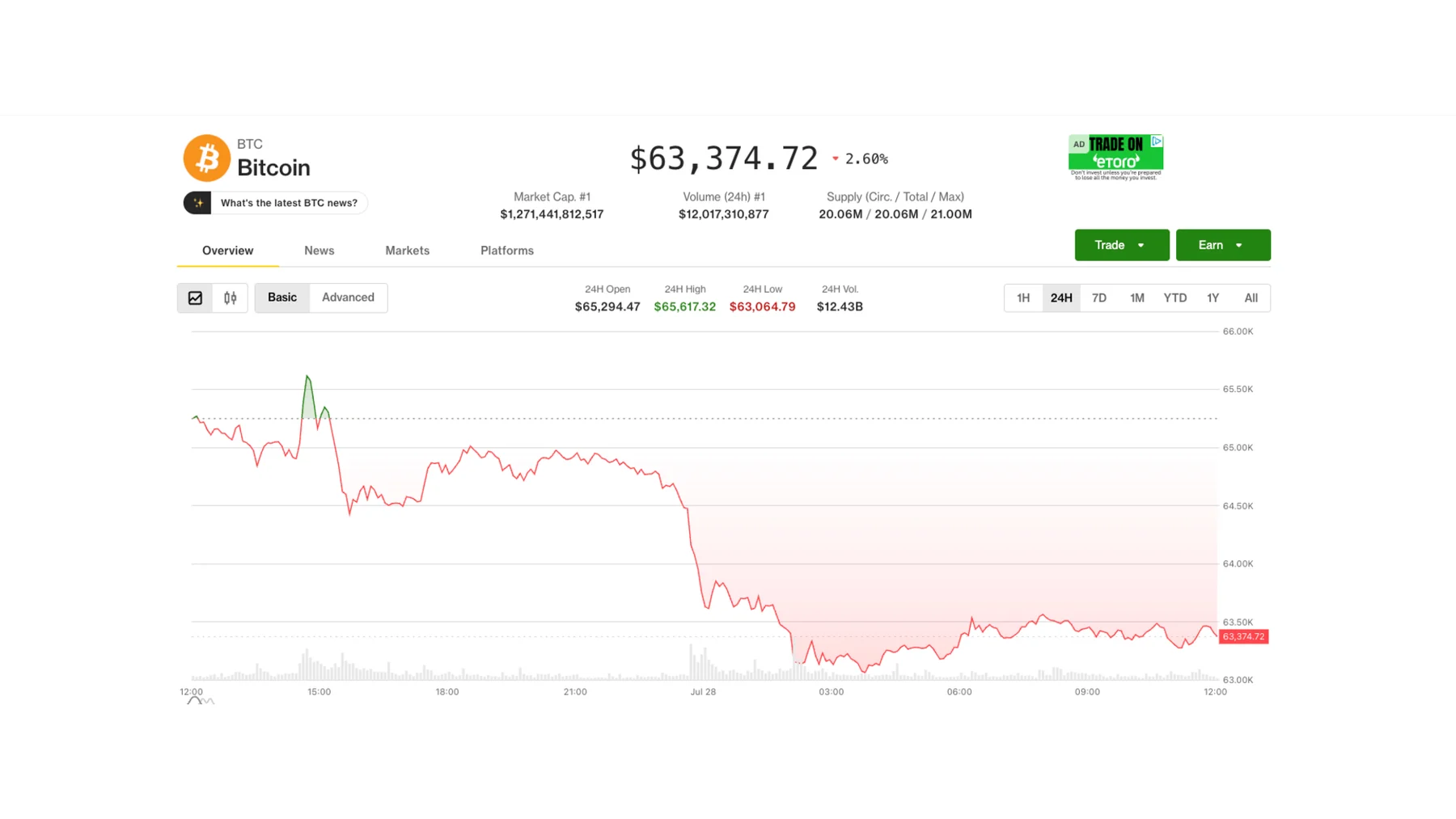
According to CoinDesk, not officially confirmed, Bitcoin fell approximately 2% as South Korea's Kospi index experienced an 11% drop, one of its worst single-day declines in years. The U.S. Senate reportedly shelved the Crypto Clarity Act to prioritize other legislative matters, leaving the crypto market in a state of uncertainty ahead of a pivotal Federal Reserve decision. These events have contributed to heightened volatility and bearish sentiment across global risk assets, especially affecting AI and layer-1 tokens.
Reported Market Movements and Context
CoinDesk has reported, though not officially confirmed, that Bitcoin experienced a notable decline of approximately 2% during the U.S. overnight trading session. This downturn coincided with a dramatic 11% plunge in South Korea's Kospi stock index, marking one of the most severe single-day losses in recent years for the Korean market. The Kospi's sharp drop sent ripples across global risk assets, affecting not only cryptocurrencies but also traditional financial instruments. The timing of these events suggests a strong correlation between traditional equity market volatility and digital asset performance, underscoring the interconnected nature of global financial systems.
The reported decline in Bitcoin and other cryptocurrencies occurred alongside broader losses in traditional markets. According to CoinDesk, Nasdaq 100 index futures fell by 0.70%, gold dropped 0.93%, and silver lost 1.50%. These figures indicate that the selloff was not limited to digital assets but was part of a wider risk-off movement affecting multiple asset classes. The simultaneous downturn in both crypto and traditional markets highlights the sensitivity of investor sentiment to macroeconomic shocks and regulatory uncertainty.
Regulatory Developments: U.S. Senate Shelves Crypto Clarity Act
CoinDesk reports, not officially confirmed, that the U.S. Senate has decided to shelve the Crypto Clarity Act in favor of prioritizing a Russia sanctions bill and federal nominations. This legislative delay comes with only two weeks remaining before the Senate's summer recess, leaving the fate of the Clarity Act uncertain for the remainder of the year. The reported shelving of the bill has introduced additional regulatory uncertainty into the crypto market, as the Act was expected to address unresolved disputes regarding restrictions on government officials' crypto holdings.
The postponement of the Crypto Clarity Act has been interpreted by market participants as a setback for regulatory progress in the United States. Without clear legislative guidance, the crypto industry faces ongoing ambiguity regarding compliance and oversight. This uncertainty has contributed to risk aversion among investors, who are now awaiting further developments from both the Senate and the Federal Reserve. The lack of official confirmation means that the precise impact of the legislative delay remains unclear, but the reported events have already influenced market sentiment.
Impact on Crypto Assets: AI and Layer-1 Tokens
CoinDesk's report, not officially confirmed, indicates that AI and layer-1 tokens bore the brunt of the overnight selloff. Tokens such as FET, NEAR, HYPE, and WLD reportedly lost between 8% and 10% over a 24-hour period, with FET leading the losses at 9.48%. The sharp decline in these assets reflects heightened sensitivity to both macroeconomic shocks and regulatory uncertainty. The selloff suggests that investors are reallocating capital away from riskier tokens, particularly those associated with emerging technologies and decentralized infrastructure.
The broader crypto market also saw notable shifts in derivatives positioning and open interest. According to CoinDesk, taker volume in futures flipped bearish, with short positions rising to 51.5%. Open interest in XRP futures increased by nearly 6%, while BTC, ETH, and SOL futures remained steady. Other tokens, including SHIB, AVAX, LINK, and DOGE, experienced declines in open interest, signaling capital outflows. These metrics collectively point to a market environment characterized by risk aversion and defensive positioning.
Derivatives and Volatility Metrics
CoinDesk reports, not officially confirmed, that several derivatives and volatility metrics have shifted in response to recent market events. The 24-hour open interest-adjusted cumulative volume delta (CVD) for the top 25 coins turned negative for the first time in at least three weeks, indicating that bearish traders are dominating price action through market orders. Funding rates for BTC hovered near 0%, suggesting balanced positioning, while those for ETH, SOL, XRP, and TRX turned negative, reflecting a growing bias toward bearish trades.
Despite the selloff, volatility surfaces for BTC and ETH remain calm, with 30-day implied volatility indexes near recent lows. This suggests that traders are not yet pricing in extreme stress, even as key events such as the Federal Reserve meeting and core U.S. PCE inflation figures approach. In options markets, put-call skews for BTC and ETH have climbed, consistent with overnight losses in spot prices. The volume rankings show puts, or downside protection, as the top choice for both BTC and ETH, indicating that investors are hedging against further declines.
Token Performance and Market Resilience
CoinDesk's report, not officially confirmed, highlights that while most tokens suffered losses, a few demonstrated resilience. Lighter (LIT) was the standout gainer, rising 3.97% to $2.21, with its $2.10 support level defended for the third time in the month. MORPHO and ethena (ENA) also posted gains, maintaining a run of DeFi resilience despite broader negative sentiment. These performances suggest that certain tokens and sectors within the crypto market can withstand broader selloffs, often due to unique fundamentals or active community support.
The CoinMarketCap 'Altcoin Season' indicator reportedly hovered at 53/100, slightly down from Monday but higher than most of July. This metric reflects ongoing rotation and selective resilience among altcoins, even as major tokens face pressure. The presence of gainers amid widespread losses indicates that market participants are still seeking opportunities in niche segments, though overall risk appetite remains subdued.
Regulatory and Macroeconomic Outlook
CoinDesk reports, not officially confirmed, that the crypto market is now facing a pivotal Federal Reserve decision, with both regulatory and macroeconomic factors looming large. The shelving of the Crypto Clarity Act leaves unresolved disputes regarding government officials' crypto holdings, while the upcoming Fed meeting and U.S. PCE inflation figures are expected to influence market direction. Investors are advised to remain attentive to these developments, as they have the potential to further impact sentiment and volatility.
The combination of regulatory delays and macroeconomic uncertainty has created a challenging environment for crypto users and investors. Without official confirmation, the precise trajectory of the market remains uncertain, but the reported events have already prompted defensive positioning and risk aversion. The next steps for market participants include monitoring legislative progress, central bank announcements, and macroeconomic indicators to better navigate the evolving landscape.
Cexvia conclusion
Concrete Finding: Market Impact from Unconfirmed South Korean Stock Plunge and U.S. Senate Delay
CoinDesk reports, not officially confirmed, that the combination of a sharp decline in South Korean equities and the U.S. Senate's shelving of the Crypto Clarity Act has triggered a downturn in Bitcoin and broader crypto markets. The affected entity is the global cryptocurrency market, with users and investors facing increased uncertainty and volatility. The immediate change is a shift toward bearish sentiment and risk aversion, while the next action is to monitor regulatory developments and central bank decisions for further impact.
- Risk meaning
- The reported events highlight the interconnectedness of global financial markets and regulatory actions with cryptocurrency price movements. Sudden declines in traditional equities and delays in crypto legislation can rapidly alter sentiment, increase volatility, and impact user portfolios. The risk is particularly acute for those holding AI and layer-1 tokens, which have seen outsized losses.
- User action
- Users and investors should remain vigilant to both macroeconomic and regulatory signals. It is advisable to closely monitor upcoming Federal Reserve decisions and legislative developments in the U.S. and other jurisdictions. Risk management strategies, such as diversification and hedging, may be prudent during periods of heightened volatility and uncertainty.
Continue reading