Market Risk
Bitcoin ETFs Shed $450 Million as Clarity Act Fails in Senate
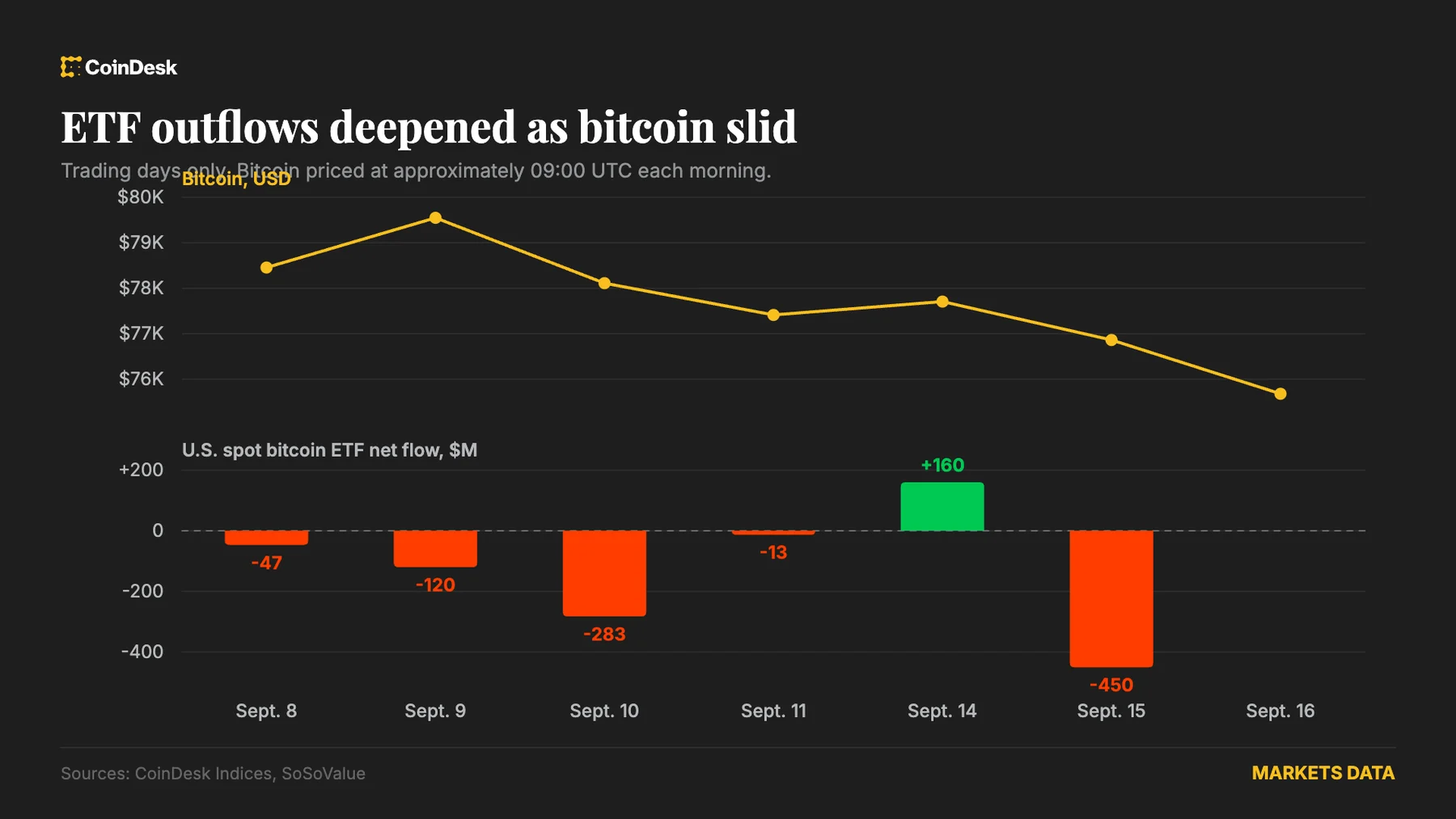
According to CoinDesk reporting, U.S. spot bitcoin ETFs shed $450 million as the Senate's failure to advance the Clarity Act sent regulatory-sensitive tokens sharply lower, though the causal link remains not officially confirmed by legislative leaders.
Legislative Stall and Market Reaction
According to CoinDesk reporting, the United States Senate failed to advance the Digital Asset Market Clarity Act during Tuesday procedural voting proceedings. The legislative motion fell approximately ten votes short of the required sixty-vote threshold necessary to overcome procedural hurdles. This unexpected political shortfall effectively concludes any realistic prospect of comprehensive digital asset market structure legislation clearing the Senate chamber throughout the remainder of 2026. Market analysts noted that seven Democratic lawmakers who had spent months directly negotiating the statutory text ultimately opposed the motion, underscoring deep partisan and procedural divisions surrounding federal oversight of blockchain technology and digital currencies within the United States.
Following this high-profile legislative setback, digital asset markets experienced immediate downward pressure across multiple sectors. CoinDesk reported that U.S. spot bitcoin exchange-traded funds recorded outflows totaling $450.33 million on Tuesday, marking the single heaviest daily capital withdrawal since June 25. While bitcoin continued trading near $75,679 with little net change since midnight Universal Time Coordinated, it remained approximately eight percent below its peak value recorded earlier in the month. Meanwhile, tokens perceived as highly sensitive to U.S. regulatory treatment suffered much steeper declines over a twenty-four-hour observation window, demonstrating how closely current market sentiment remains tied to federal policymaking and statutory developments in Washington.
Derivatives Liquidation and Leverage Pressures
The abrupt legislative failure triggered widespread forced deleveraging across global cryptocurrency derivatives exchanges. CoinDesk noted that leveraged futures positions valued in excess of $570 million were forcibly liquidated within a twenty-four-hour window, representing the highest volume of liquidations observed since August 22. Despite this substantial washout, market commentators pointed out that the volume remained considerably below the massive liquidations recorded during severe market stress events in February and June. The taker long-short volume ratio shifted toward a bearish stance, with short transactions accounting for approximately fifty-one point five percent of total trading flow as aggressive sellers drained available liquidity across order books.
Open interest metrics across major cryptocurrencies presented a complex picture of ongoing trader positioning during the sell-off. Bitcoin futures open interest ticked upward slightly even as spot prices retreated, a pattern that industry analysts traditionally interpret as an indicator of aggressive short-term positioning by bearish traders. Furthermore, cumulative volume delta metrics for bitcoin and prominent alternative tokens remained predominantly negative, confirming persistent selling pressure executed directly at prevailing market prices rather than through passive limit orders. Although perpetual funding rates for certain assets continued to reflect lingering optimism among niche retail participants, the broader derivatives landscape signaled heightened vulnerability to further downside volatility.
Alternative Token Divergence and Sector Resilience
While flagship digital assets bore the brunt of regulatory-driven liquidations, selected altcoins demonstrated notable divergence and idiosyncratic price action. CoinDesk highlighted that privacy-focused digital assets emerged as relative outperformers during the broader market downturn, with Zcash leading the sector after registering a solid daily gain, supported by consistent trading interest in privacy narratives. Conversely, regulatory-sensitive tokens such as Stellar and XRP experienced severe pullbacks, losing substantial value over twenty-four hours as market participants reassessed compliance risks following the congressional stalemate. Decentralized finance tokens also faced broad-based selling, although specific project founders publicly downplayed the immediate operational impact of U.S. legislative developments on their localized user bases.
Trading anomalies in smaller-cap tokens underscored the speculative nature of parts of the broader altcoin ecosystem during periods of macro uncertainty. CoinDesk reported instances where specific tokens experienced massive futures volume and open interest expansions that dwarfed their circulating market capitalization, classic indicators of short-squeeze dynamics rather than organic spot demand. Such trading configurations reinforce the necessity for institutional and retail market participants to distinguish between genuine structural growth and short-lived derivative-driven anomalies. As traditional financial markets remained relatively steady with modest gains in equity index futures and precious metals, the digital asset ecosystem continued to grapple with distinct regulatory and liquidity challenges.
Broader Market Context and Macroeconomic Focus
Market attention quickly shifted from the congressional defeat to upcoming macroeconomic announcements from the Federal Reserve, which scheduled its interest rate decision for later in the day. Industry participants had entered the week treating an interest rate increase as the primary baseline scenario, though lingering debates persisted regarding potential alternative outcomes. Unlike the violent swings observed across cryptocurrency exchanges, traditional financial markets displayed remarkable resilience and calm. Nasdaq 100 index futures posted modest gains, gold and silver prices advanced steadily, and the benchmark U.S. Dollar Index remained virtually unchanged throughout the unfolding crypto market volatility.
Options market positioning ahead of the central bank policy announcement reflected a nuanced distribution of trader sentiment across different token categories. CoinDesk noted that thirty-day implied volatility indexes for both bitcoin and ether remained exceptionally calm within recent historical ranges, sitting well beneath their year-to-date peaks and suggesting traders were not aggressively pricing an immediate volatility surge surrounding the rate decision. However, options skew metrics for major assets pointed toward growing institutional and retail demand for downside protection and put options, while short-term trading volume in bitcoin options remained concentrated in bullish call contracts, illustrating the persistent complexity of cross-market expectations.
Conclusion and Strategic Risk Assessment
In conclusion, independent reporting by CoinDesk established that U.S. spot bitcoin ETFs experienced $450.33 million in single-day outflows following the legislative failure of the Clarity Act in the Senate. This event directly impacted digital asset investors, ETF holders, and leveraged derivatives traders across multiple global exchanges. However, the precise causal attribution between the legislative stalemate and the capital outflows remains not officially confirmed by legislative authorities or first-party issuers. Market participants must now account for heightened regulatory deadlock through the remainder of 2026, as split congressional control expected in January effectively shelves major market structure reforms.
As the immediate next action, affected entities and leveraged traders should immediately audit their collateral ratios, reduce excessive margin exposure, and monitor incoming macroeconomic data releases from the Federal Reserve. Given that the reported $450 million outflow and associated market slides reflect journalistic observation rather than official confirmation, risk managers must maintain dynamic surveillance protocols. Exchange operators and institutional desks are advised to prepare for prolonged regulatory uncertainty while enforcing stringent risk controls to navigate potential downstream volatility effectively.
Cexvia conclusion
Comprehensive Conclusion and Forward Action
CoinDesk reported that U.S. spot bitcoin ETFs lost $450.33 million following the legislative setback in the Senate, affecting digital asset investors and leveraged traders, with the legislative impact remaining not officially confirmed by congressional officials.
- Risk meaning
- The legislative failure highlights immediate vulnerability to U.S. regulatory developments and policy deadlocks, triggering rapid capital flight from spot investment products and aggressive derivatives liquidations across multiple trading venues.
- User action
- Market participants should closely monitor upcoming Federal Reserve interest rate announcements, reduce excessive leverage in perpetual futures positions, and maintain heightened risk management discipline amid ongoing regulatory uncertainty.
Continue reading