Market Risk Intelligence
Bitcoin Rebounds Toward $64,000 Amid Coldcard Exploit and Strategy Sales, While ADA Rallies
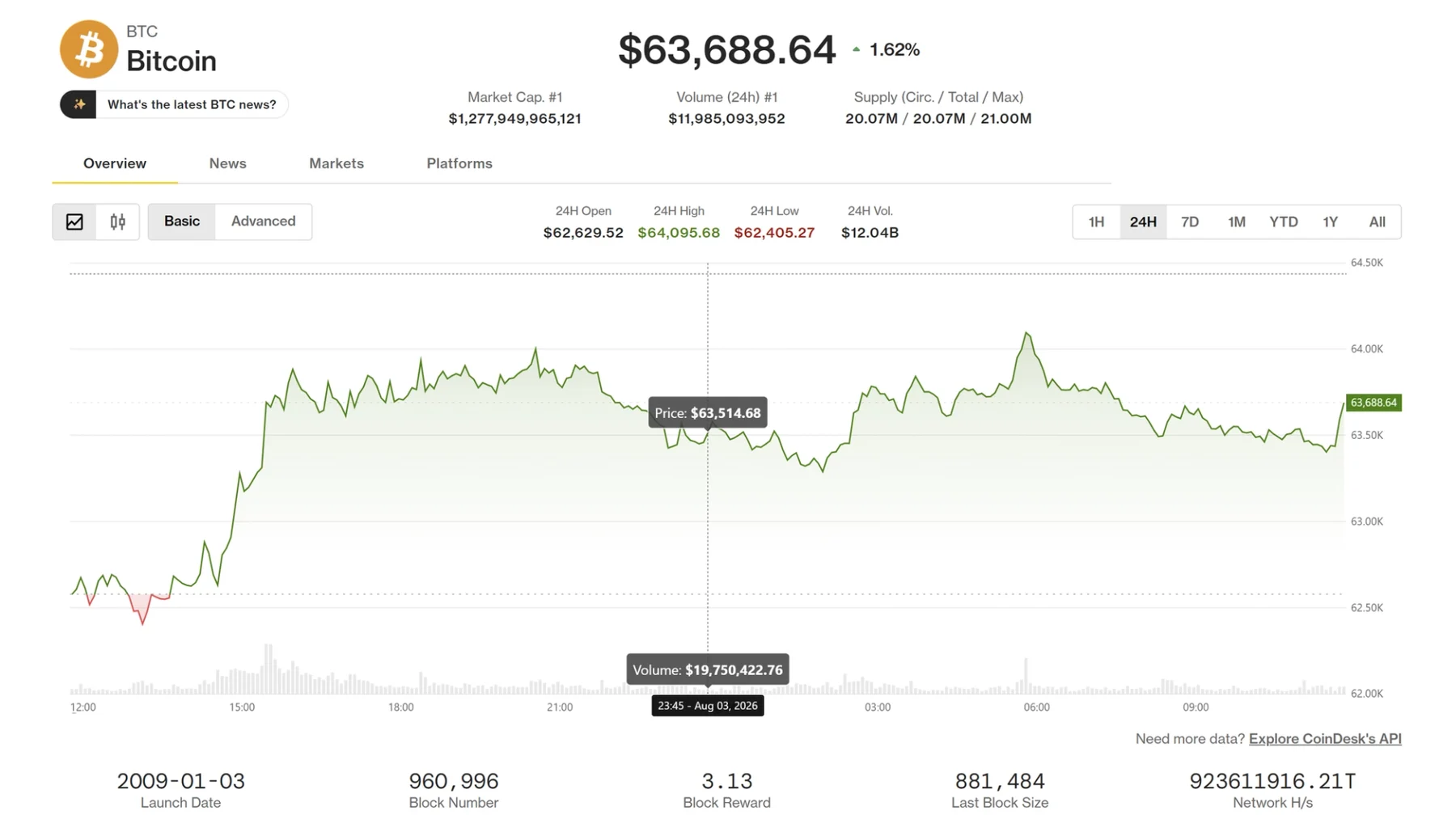
According to reporting by CoinDesk published on August 4, 2026, bitcoin advanced toward $64,000 as the broader market settled down following a weekend exploit targeting Coldcard wallets and corporate treasury sales by Strategy, although overall market sentiment remains anchored in extreme fear. This development, which is not officially confirmed by all independent forensic auditors, highlights ongoing security vulnerabilities in hardware wallet firmware infrastructure and corporate liquidity management strategies within the digital asset ecosystem.
Market Rebound Amid Security Concerns and Corporate Liquidations
According to reporting published by CoinDesk on August 4, 2026, bitcoin recovered toward the $64,000 threshold as market participants absorbed the ramifications of a significant security exploit affecting Coldcard wallets over the preceding weekend. The premier digital asset climbed to approximately $64,160, marking its strongest performance since late July, before encountering localized resistance and retreating slightly. This recovery materialized despite lingering negative sentiment across the broader digital asset landscape, where the benchmark Crypto Fear and Greed Index languished firmly in extreme fear territory at a reading of 25. Market analysts tracking the price action noted that spot bitcoin exchange-traded funds experienced substantial volatility, registering net outflows of over sixty million dollars during the prior week, followed by a partial inflow reversal at the start of the new trading cycle.
Concurrently, the market had to digest substantial asset disposals executed by corporate treasury giant Strategy. Between late July and early August, the corporate holder liquidated 1,638 bitcoin at an average execution price of roughly $63,957. This transaction represented the entity's third major asset offloading of the calendar year, executed notably below its aggregate historical average acquisition cost. Management officials utilized the resulting capital proceeds to service dividend obligations and execute share buyback programs for its specialized preferred stock equity vehicle. While these corporate liquidity maneuvers introduced notable supply pressure into the open market, spot buyers managed to absorb the distributed coins, preventing a more catastrophic downward cascade and allowing the digital asset to sustain its recovery trajectory toward the mid-sixty-thousand-dollar resistance band.
Firmware Vulnerabilities and Cold Storage Security Realities
Independent researchers monitoring blockchain activity reported that approximately 1,816 bitcoin, valued at roughly $114 million, were extracted from more than 5,200 unique addresses beginning in late July. The malicious extraction campaigns were directly linked to a structural vulnerability discovered within the firmware infrastructure of Coldcard hardware wallets. Security professionals and the hardware manufacturer immediately urged impacted users to relocate their digital holdings to secure destinations while remediation patches and mitigation strategies were evaluated. This incident underscores the persistent vulnerability of hardware storage solutions when hidden firmware flaws are successfully weaponized by sophisticated threat actors targeting private keys.
The ongoing security scare serves as a stark reminder that physical separation from internet connectivity does not render cold storage architectures entirely immune to sophisticated compromise. As investigators continue to trace the illicit movement of funds across multiple decentralized and centralized platforms, users holding assets on vulnerable firmware versions face acute risks of complete capital loss. The disclosure emphasizes the critical necessity for continuous firmware auditing, rapid vulnerability disclosure frameworks, and comprehensive multi-layered security protocols across all hardware wallet manufacturers operating within the global cryptocurrency ecosystem.
Cardano Outperformance and Ecosystem Dynamics
Cardano's native token ADA emerged as a prominent outlier within an otherwise subdued and listless altcoin sector, surging to its highest valuation in over a month. Market intelligence data indicates that the token capitalized on strong buying pressure originating from a steadily shrinking holder base, coupled with meaningful technological upgrades across its underlying decentralized network. Specifically, data analytics revealed that the Cardano network recorded thousands fewer non-empty wallet addresses compared to the preceding two-month period, signaling that retail participants were exiting the market while high-conviction holders aggressively absorbed the resulting circulating supply.
This dynamic of rising valuations accompanied by contracting address counts typically signifies strong conviction among remaining participants, though it also points to a potentially thin underlying rally. Furthermore, fundamental ecosystem developments provided tangible support for the price expansion beyond mere speculative sentiment. Ongoing advancements included progress on the Leios testnet, enhancements to the Hydra scaling infrastructure, Mithril protocol upgrades, Pyth price-feed integration, and fresh Catalyst funding allocations designed to stimulate developer adoption. These concrete network milestones helped validate the spot market rally, distinguishing ADA from other alternative tokens that remained range-bound or trended downward.
Derivatives Positioning and Hedging Behavior in Alternative Tokens
Derivatives market metrics revealed complex positioning structures, particularly across major alternative tokens such as ATOM and ADA, where open interest reached unprecedented heights. For ATOM, perpetual futures open interest approached record levels of approximately eighty million tokens, yet annualized perpetual funding rates and cumulative volume delta metrics remained persistently negative. This stark divergence signaled a pronounced institutional bias toward short positions and bearish hedging strategies, indicating that the recent spot price appreciation was heavily cushioned or counterbalanced by speculative derivative shorting rather than organic, unhedged bullish accumulation.
Conversely, Cardano's ADA displayed a significantly more constructive derivatives profile, characterized by record-high open interest of nearly 2.79 billion coins alongside positive cumulative volume delta values and slightly favorable funding rates. These metrics confirmed that buyers were executing aggressive market orders rather than passive limit orders, validating the underlying strength of the spot market advance. Meanwhile, flagship assets such as bitcoin and ether exhibited relatively listless futures positioning, with open interest stabilizing within established historical ranges and implied volatility indices dipping toward multi-month lows, reflecting an overall atmosphere of cautious market equilibrium.
Macroeconomic Pressures and Currency Interventions
Broader macroeconomic currents also exerted notable influence over cryptocurrency market sentiment, highlighted by a sharp depreciation of the Japanese yen following confirmed coordinated foreign exchange intervention by United States and Japanese monetary authorities. U.S. Treasury Secretary Scott Bessent confirmed joint participation in stabilizing currency valuations, reviving market comparisons to the turbulent carry-trade unwinding episodes observed in August 2024. Currency fluctuations introduced additional layers of volatility across global financial markets, as traders reassessed cross-border capital allocations and risk-adjusted return profiles in response to aggressive central bank interventions.
Despite the dramatic currency swings, quantitative assessments of bitcoin's annualized fifty-two-week correlation with the dollar-yen pairing registered a negative ninety percent coefficient, indicating that broader dollar strength remained the dominant systemic risk factor for digital assets. The interplay between foreign exchange policy adjustments, shifting interest rate expectations, and institutional treasury liquidations created a multifaceted risk environment. Market participants were forced to navigate both internal crypto-specific exploits and external macroeconomic shocks, reinforcing the necessity for rigorous risk management frameworks and constant surveillance of global liquidity conditions.
Definitive Risk Assessment and Mandatory Next Actions
Cexvia risk analysts have established a concrete finding based on the reported market developments. The affected entity in this context is Strategy, along with retail and institutional holders of Coldcard hardware wallets, while the primary user group consists of cryptocurrency investors, cold storage device owners, and token traders operating within global derivatives markets. It is important to emphasize that these reports of firmware exploits and corporate liquidations are reported by media sources and have not been officially confirmed by all independent forensic authorities. What changes now is that market participants must operate under heightened security awareness, acknowledging that physical hardware storage devices require rigorous firmware validation and that corporate treasury liquidations can introduce sudden, unpredictable spot supply pressures.
As a mandatory next action, all affected users and market participants must immediately inspect their hardware wallet firmware versions, isolate funds from compromised or outdated devices, and implement strict risk management protocols across all derivatives trading activities. Furthermore, traders should refrain from deploying excessive leverage while market sentiment remains anchored in extreme fear, and they must maintain continuous vigilance regarding corporate balance sheet adjustments and macroeconomic currency shifts. Independent verification of all security patches remains paramount before resuming normal transactional activities across vulnerable storage configurations.
Cexvia conclusion
Definitive Risk Assessment and Mandatory Next Actions
Cexvia risk analysts observed that bitcoin climbed toward $64,000 despite reported security breaches affecting Coldcard hardware wallets and ongoing bitcoin liquidations by Strategy. This assessment, which is not officially confirmed, underscores that retail and institutional participants must navigate complex risks involving firmware vulnerabilities, concentrated corporate treasury liquidations, and shifting derivatives positioning across major public blockchains.
- Risk meaning
- The convergence of hardware wallet firmware vulnerabilities, corporate treasury liquidations, and heightened derivatives hedging demonstrates that structural vulnerabilities continue to threaten digital asset market stability. When hardware infrastructure is compromised and corporate entities execute large-scale offloading to service financial obligations, spot prices face severe downward pressure, even if temporary rebounds occur due to aggressive short-term buying in select alternative tokens.
- User action
- Traders and long-term holders should immediately audit their hardware security practices, verify firmware integrity for cold storage devices, and monitor corporate treasury movements closely. Market participants should also implement strict risk management protocols, avoid excessive leverage in alternative token derivatives, and maintain conservative capital allocations while market sentiment remains fragile.
Continue reading