Regulatory Risk
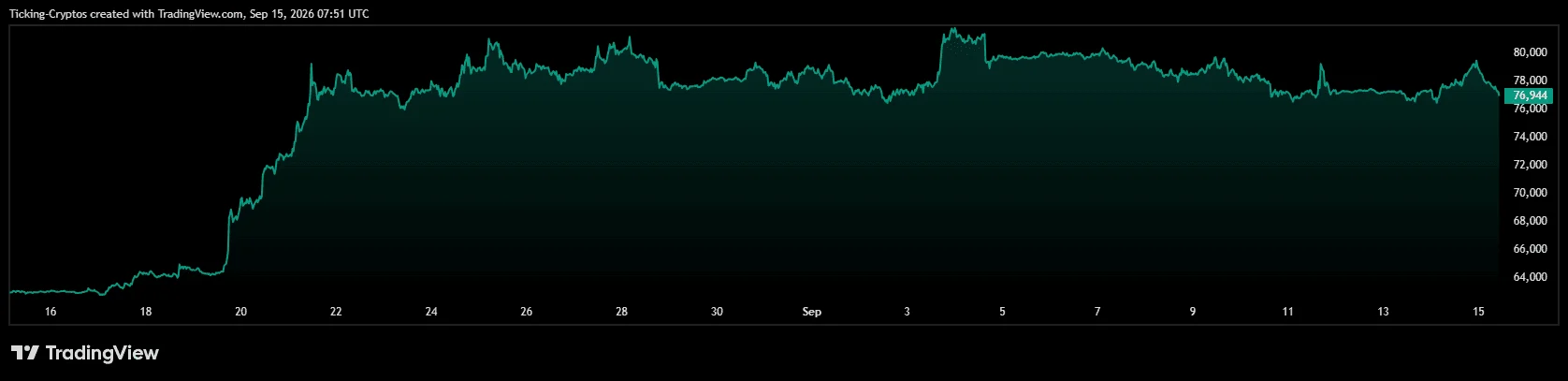
Bitcoin Stuck Near $77,000 as the Fed and the CLARITY Act Collide
According to CryptoTicker reporting, digital asset markets stalled as investors weighed a Senate cloture vote on the Digital Asset Market Clarity Act alongside an anticipated Federal Reserve rate hike. This reporting has not officially confirmed the final legislative outcome or macro policy shifts.
Macroeconomic Pressures and Institutional Flow Cooling
According to CryptoTicker, digital asset valuations encountered substantial macro headwinds as market expectations shifted toward potential monetary tightening by the Federal Reserve. Previous rallies driven by United States spot exchange-traded fund inflows experienced a noticeable deceleration as institutional participants reduced aggressive accumulation strategies. Market analysts noted that the preceding influx of capital into Bitcoin products had cooled significantly, transitioning from robust multi-week inflow streaks into periods of net outflows across consecutive trading sessions. This shift in institutional behavior reflects a broader hesitation among large-scale allocators who prefer to observe macroeconomic catalysts before committing fresh capital to risk-on digital assets.
Furthermore, the reported cooling in institutional participation did not trigger immediate distress among long-term holders, whose sell-side risk metrics remained subdued compared to historical cycle peaks. On-chain analytics cited by the publisher indicated that veteran coin supplies remained largely dormant, suggesting that core holders were not driving the recent price stagnation. Instead, the absence of aggressive new demand left major cryptocurrencies vulnerable to broader macroeconomic signals and interest rate adjustments. Consequently, market participants found themselves navigating a cautious trading environment defined by contracting liquidity and heightened sensitivity to external monetary policy pronouncements.
Legislative Uncertainty Surrounding the CLARITY Act
The reported legislative landscape centers on the United States Senate cloture vote concerning the Digital Asset Market Clarity Act, an initiative designed to establish statutory boundaries between the Securities and Exchange Commission and the Commodity Futures Trading Commission. Publisher reporting highlighted that the proposed legislation aims to grant the commodity regulator exclusive oversight over digital commodity spot markets while preserving securities definitions for other digital assets. Despite having previously cleared the House of Representatives and the Senate Banking Committee, the bill encountered substantial hurdles related to ethics provisions, stablecoin mechanics, and illicit finance language, leading to a notable decline in prediction market confidence.
Industry observers emphasized the asymmetric risk profile associated with the legislative procedure, where a procedural failure could permanently stall comprehensive market structure reform ahead of impending midterm elections. Such an outcome would likely prolong regulatory enforcement approaches for several years, imposing structural headwinds on digital asset issuers and trading platforms. Conversely, a successful procedural vote would primarily offer a sentiment boost rather than immediate statutory implementation. This delicate balance has discouraged aggressive positioning among institutional and retail traders alike, leaving asset valuations closely tethered to the outcome of congressional deliberations.
Major Asset Performance and Capital Rotation Dynamics
Bitcoin trading metrics demonstrated continued consolidation below key psychological thresholds, with market capitalization remaining compressed relative to prior cycle peaks. According to CryptoTicker, Bitcoin dominance climbed toward fifty-nine percent, indicating that available capital was actively rotating inward from alternative cryptocurrencies rather than exiting the broader ecosystem entirely. Technical indicators suggested elevated average true ranges and negative momentum histograms, pointing toward potential volatility surrounding upcoming macroeconomic data releases. Key support levels near the seventy-three thousand dollar mark and resistance near eighty thousand dollars continued to define the primary trading range for market participants.
Meanwhile, alternative assets displayed divergent performance characteristics, with Ethereum experiencing stable fund inflows despite flat weekly price action, while XRP attracted notable institutional allocations amid speculation regarding regulatory clarification. Conversely, high-beta assets such as Solana faced downward pressure as rising Bitcoin dominance and macroeconomic uncertainty prompted profit-taking among leveraged traders. These mixed sector dynamics underscore a bifurcated market where specific tokens derive localized momentum from ETF product listings and regulatory expectations, while others struggle against broader macroeconomic headwinds.
Privacy Sector Resilience and Regulatory Scrutiny
Privacy-focused cryptocurrencies emerged as a distinct sector outlier, recording substantial year-to-date gains driven by the introduction of United States spot exchange-traded products. Publisher reporting detailed how Zcash and Monero achieved significant upward price movements amid broader market stagnation, bolstered by substantial institutional asset accumulation following initial exchange-traded fund listings. This surge propelled privacy asset market capitalization to multi-year highs, making it one of the few crypto sectors trading well above prior cycle benchmarks as traders sought alternative exposure narratives.
However, this sector rally is accompanied by notable structural risks, including elevated futures open interest and impending regulatory restrictions across international jurisdictions. Specifically, European Union anti-money laundering regulations scheduled to take effect in July 2027 threaten to ban custodial support for anonymity-enhancing coins, prompting several regulated venues to delist affected tokens. These impending compliance mandates introduce significant operational hazards for institutional investors and custodians engaging with privacy assets, necessitating careful risk assessment alongside speculative positioning.
Conclusion and Market Outlook
In conclusion, CryptoTicker reporting indicates that digital asset markets remain precariously positioned as they await the outcomes of the Senate CLARITY Act cloture vote and the Federal Reserve rate decision. Affected entities include centralized exchanges, digital asset investment funds, and retail traders exposed to high-beta tokens and regulatory-sensitive altcoins. These legislative and macroeconomic developments are not officially confirmed by regulatory or central bank authorities. Market participants must distinguish between reported procedural timelines and officially verified policy enactments when evaluating portfolio risk.
As a next action, market participants and risk managers should closely track the official legislative voting tallies and the Federal Reserve statement for definitive signals. Exchange operators and institutional desks are advised to maintain robust monitoring of leverage parameters, liquidity conditions, and compliance frameworks to mitigate sudden volatility resulting from unresolved regulatory and macroeconomic catalysts.
Cexvia conclusion
Conclusion and Next Actions
According to CryptoTicker reporting, market participants faced structural exposure as legislative votes and macroeconomic pressures converged, though these developments are not officially confirmed by regulatory or central bank authorities.
- Risk meaning
- The reported convergence of regulatory uncertainty and potential monetary tightening creates asymmetric risks for digital asset traders, particularly affecting assets dependent on statutory clarity or spot ETF inflows.
- User action
- Market participants should monitor Senate voting outcomes and Federal Reserve statements closely while managing leverage and exposure to high-beta tokens.
Continue reading