Market Risk and Protocol Security
Bitcoin Holds Near $64,000 as Macro Pressures Loom and Harmony Suffers Major Token Exploit
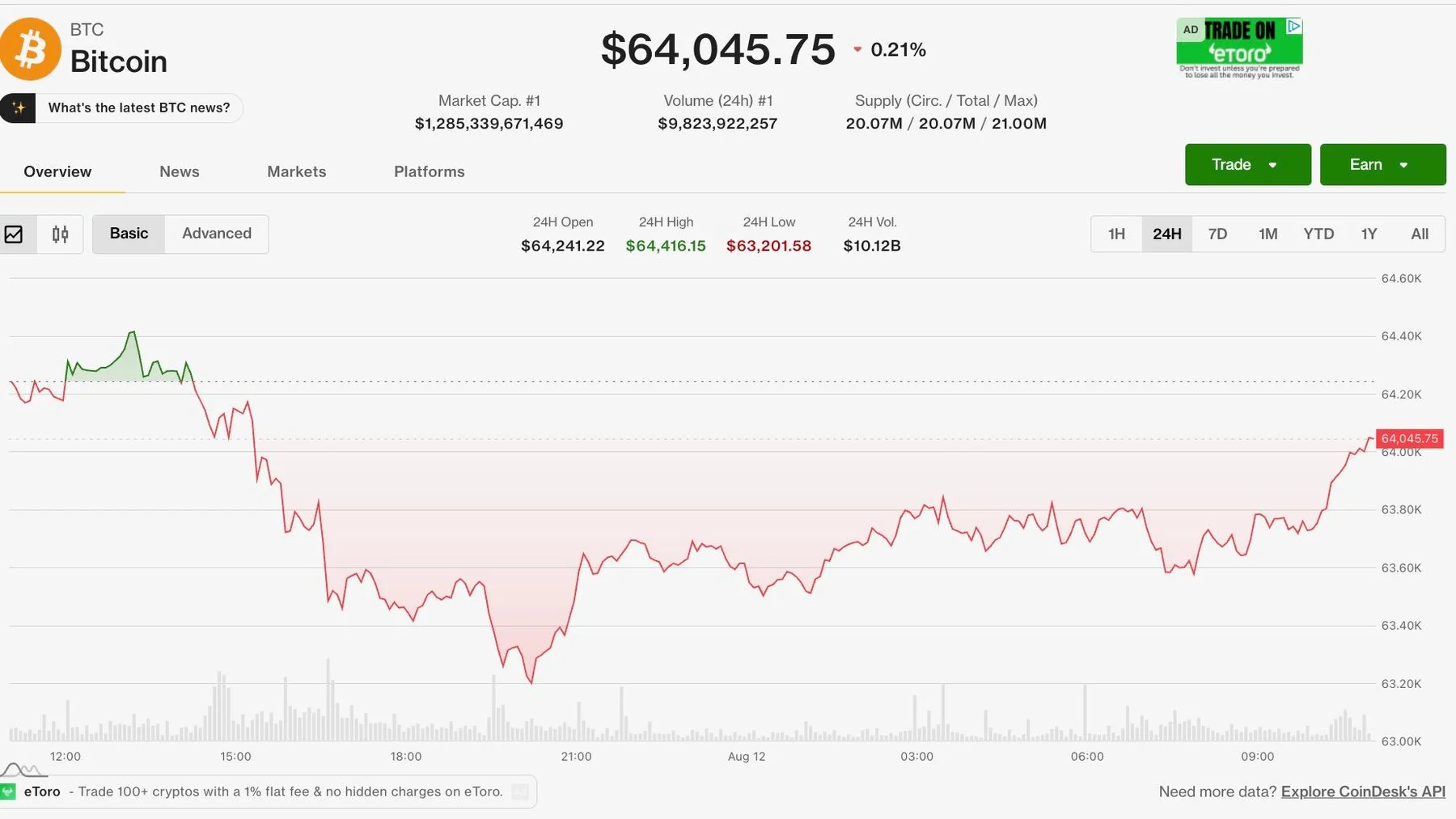
According to reporting by CoinDesk, digital asset markets remained relatively subdued while awaiting critical U.S. inflation data, even as bitcoin held near $64,000 and Brent crude hovered around $90. Concurrently, the layer-1 blockchain Harmony suffered a significant protocol security incident involving an unauthorized minting event of approximately 4 billion tokens, which has not officially confirmed broader contagion across other major decentralized finance infrastructure.
Protocol Security Incident and Asset Devaluation
According to reporting published by CoinDesk, the layer-1 blockchain network Harmony experienced a severe protocol breach early in the Asian trading session. The reported exploit involved an attacker generating approximately four billion ONE tokens through empty blocks, a volume estimated to comprise roughly twenty-six percent of the network's total circulating supply. This unprecedented influx of newly minted tokens created immediate downward pressure on the market price, causing the asset to plummet by as much as forty percent to reach a new record low. Media coverage highlighted that a substantial portion of these compromised tokens, amounting to nearly 2.8 billion units, was swiftly directed toward various trading venues, amplifying the catastrophic decline in market valuation and shocking the broader decentralized finance community.
While the immediate physical manifestation of the attack involved massive token dilution, the underlying mechanisms that permitted the generation of empty blocks with unauthorized minting permissions remain a subject of ongoing technical analysis. Market observers noted that such dramatic supply expansions test the resilience of automated market makers and liquidity pools that host the affected asset, as arbitrageurs and panicked holders rush to exit positions. However, the exact technical vector exploited by the malicious actor has not been independently verified through a comprehensive forensic audit, leaving market participants to rely on preliminary disclosures. Furthermore, the broader contagion effects across other interconnected decentralized finance protocols on the Harmony network remain unconfirmed by formal security investigators, creating an atmosphere of heightened uncertainty.
Macroeconomic Backdrop and Energy Market Pressures
Financial markets across the globe maintained a cautious posture as traders awaited the release of critical United States consumer price index data scheduled for publication at twelve-thirty UTC. This macroeconomic indicator traditionally dictates the short-term trajectory for risk assets, including cryptocurrencies, by shaping expectations regarding central bank monetary policy adjustments. Ahead of this anticipated print, major benchmarks exhibited minimal net change, reflecting a generalized hesitancy among institutional allocators who preferred to remain sidelined until definitive inflationary trends were officially recorded and analyzed by economic statisticians.
Simultaneously, energy markets experienced renewed volatility driven by escalating geopolitical tensions in key shipping corridors. Brent crude oil prices hovered near ninety dollars per barrel following reports of fresh militant attacks on commercial shipping vessels in the Bab el-Mandeb Strait alongside a United States military strike in the Gulf of Oman overnight. These disruptions to vital maritime supply routes introduced complex inflationary pressures that complicated the broader economic outlook, feeding anxiety into risk-sensitive sectors. Despite these compounding external shocks, digital asset markets demonstrated remarkable short-term resilience, though analysts warned that sustained high energy costs could ultimately constrain broader economic liquidity and dampen risk appetite across financial ecosystems.
Bitcoin Resilience and Derivatives Positioning Shifts
Bitcoin prices demonstrated relative stability amidst the confluence of protocol exploits and macroeconomic uncertainty, holding near the sixty-four thousand dollar threshold with a minor positive shift of twenty-three basis points since midnight UTC. Market participation in the primary digital asset remained subdued, with open interest hovering below seven hundred and fifty thousand bitcoin, a metric indicating that institutional and retail participants were largely adopting a wait-and-see approach. Concurrently, the Crypto Fear and Greed Index registered a reading of thirty-eight, signifying a prevailing sentiment of fear that contrasted sharply with the relatively calm spot price action observed across major order books.
Beneath the surface of seemingly stable futures markets, underlying positioning data revealed a notable bearish shift in taker sentiment among active market participants. Takers, defined as traders executing market orders that actively remove liquidity from order books, flipped their aggregate exposure to a net short bias, with short positions accounting for over fifty-one percent of total activity. This structural reversal from the bullish bias recorded earlier in the week suggests that aggressive market sellers are positioning for potential downside breaks, even as passive limit-order activity remains relatively balanced across the premier cryptocurrency trading venues.
Altcoin Sector Pressures and Leverage Accumulation
The broader altcoin market exhibited widespread selling pressure, with the majority of the top twenty-five cryptocurrencies registering negative twenty-four-hour cumulative volume deltas according to data cited in the source publication. Notable exceptions such as Chainlink, Cronos, and Tron displayed isolated positive momentum, but the sector as a whole remained weighed down by systemic caution and liquidity fragmentation. Furthermore, Avalanche experienced aggressive shorting activity, characterized by a six percent increase in open interest accompanied by declining spot prices, confirming that downward momentum was being actively driven by market-order sellers rather than passive liquidations.
At the same time, speculative leverage continued to build significantly within specific alternative token markets, most notably in Dogecoin futures where open interest surpassed seventeen billion tokens, reaching levels unseen since October. This substantial accumulation of leveraged positions during a prolonged period of sideways price action near the seven-cent level suggests that the market is coiling for a major volatility expansion. Analysts observing these leverage metrics cautioned that such concentrated positioning increases the probability of cascading liquidations should price action breach established technical support or resistance boundaries in either direction.
Options Market Dynamics and Implied Volatility Trends
Options trading activity reflected a peculiar divergence between depressed short-term volatility expectations and targeted directional positioning among sophisticated market participants. Bitcoin's thirty-day implied volatility index experienced downward pressure, receding to thirty-seven point five percent, while short-dated one-week implied volatilities remained exceptionally low. This compressed volatility pricing indicated that options traders were not aggressively pricing in immediate turbulence ahead of the U.S. inflation data release, potentially leaving the market underprepared for unexpected macroeconomic surprises.
Despite the subdued volatility indexes, specific strike concentrations in the Deribit options market revealed active hedging and speculative strategies aimed at potential tail events. The seventy thousand dollar call option remained the most actively traded contract for consecutive sessions, while institutional preference grew for strangle strategies involving the simultaneous acquisition of puts and calls. This dual positioning strategy demonstrates that while overall market momentum appears range-bound, professional traders are deliberately structuring portfolios to extract profits from a sharp, unannounced breakout in either direction following the macro data resolution.
Token-Specific Performance and Sector Divergence
Individual digital assets displayed pronounced performance divergences throughout the reporting period, driven by tokenomics updates and sector-specific sentiment shifts. Curve Finance emerged as a standout performer among major altcoins, advancing roughly thirty-five percent over a seven-day period to trade near twenty-eight cents, supported by an impending fifteen percent annual emissions reduction protocol adjustment. Conversely, Uniswap experienced a double-digit percentage decline over twenty-four hours without a distinct fundamental catalyst, underscoring the ongoing vulnerability of mid-tier altcoins to sudden liquidity withdrawals and thin order book depth.
Meanwhile, privacy-focused assets and artificial intelligence tokens experienced localized recoveries, with Monero retracing its previous losses and AI-themed tokens such as NEAR Protocol, Fetch.ai, and Bittensor posting modest gains of between one point three and two point three percent. This uneven recovery across thematic sectors indicates that capital is rotating selectively based on narrative catalysts rather than participating in a broad-based market rally, leaving secondary tokens highly dependent on idiosyncratic developments and speculative interest.
Cexvia conclusion
Comprehensive Assessment of Reported Market Pressures and Protocol Vulnerabilities
CoinDesk reported that Harmony experienced an exploit where an attacker minted approximately 4 billion ONE tokens via empty blocks, representing about 26% of the total circulating supply. This incident triggered a severe price contraction for the asset, driving it down to historic lows as large volumes were funneled to digital asset exchanges. The exact vector of the exploit and the full extent of recovery prospects remain unverified by independent cryptographic audits, and the situation is not officially confirmed beyond initial media reports.
- Risk meaning
- The combination of sudden protocol exploitation and impending macroeconomic data releases introduces acute operational and systemic vulnerabilities for market participants. When a network encounters unauthorized token minting of this magnitude, liquidity providers, decentralized exchanges, and centralized trading venues face immediate asset devaluation and potential cascading collateral failures. Furthermore, derivatives markets exhibiting bearish taker dominance and leveraged buildup in alternative assets highlight heightened fragility against unexpected external shocks.
- User action
- Traders and asset holders interacting with vulnerable layer-1 networks or decentralized finance protocols should immediately review their exposure, decouple interconnected collateral arrangements, and monitor official channel announcements. Participants maintaining open leveraged positions in alternative cryptocurrencies should exercise heightened caution regarding volatility expansion and potential liquidity crunches across trading platforms.
Continue reading