Regulatory Risk
Senate Rejects Clarity Act as Crypto Markets Slide Amid Macro Pressures
According to reporting by CoinDesk, the United States Senate failed to advance the Digital Asset Market Clarity Act in a procedural vote, bringing legislative efforts concerning crypto market structure to a halt for 2026. This development is not officially confirmed by government or parliamentary bodies directly, but relies on journalistic coverage and unofficial floor tallies.
Legislative Stalled Proceedings
According to reporting published by CoinDesk, the United States Senate did not secure the necessary support to advance the Digital Asset Market Clarity Act during a critical procedural vote. The legislative initiative required a sixty-vote threshold to clear the cloture motion and move forward to formal floor debate and subsequent amendments. However, persistent disagreements between Republican sponsors and Democratic lawmakers regarding ethics provisions and oversight boundaries ultimately derailed the fragile bipartisan compromise. The reported failure effectively concludes market structure legislative ambitions in the Senate for the year 2026, leaving industry participants without a unified federal framework for digital asset classification.
Analysts cited by CoinDesk noted that the breakdown in negotiations stemmed from unresolved concerns over executive branch potential conflicts and regulatory jurisdiction divisions between the Securities and Exchange Commission and the Commodity Futures Trading Commission. Although legislative staffers continued discussions right up to the commencement of the vote, prediction markets had already begun pricing in a low probability of passage as counter-proposals were rejected. Industry advocates expressed deep frustration over the outcome, emphasizing that years of advocacy and substantial financial investments by stakeholders have failed to yield statutory clarity from Congress, forcing firms to continue navigating a patchwork of regulatory interpretations.
Market Reactions and Asset Declines
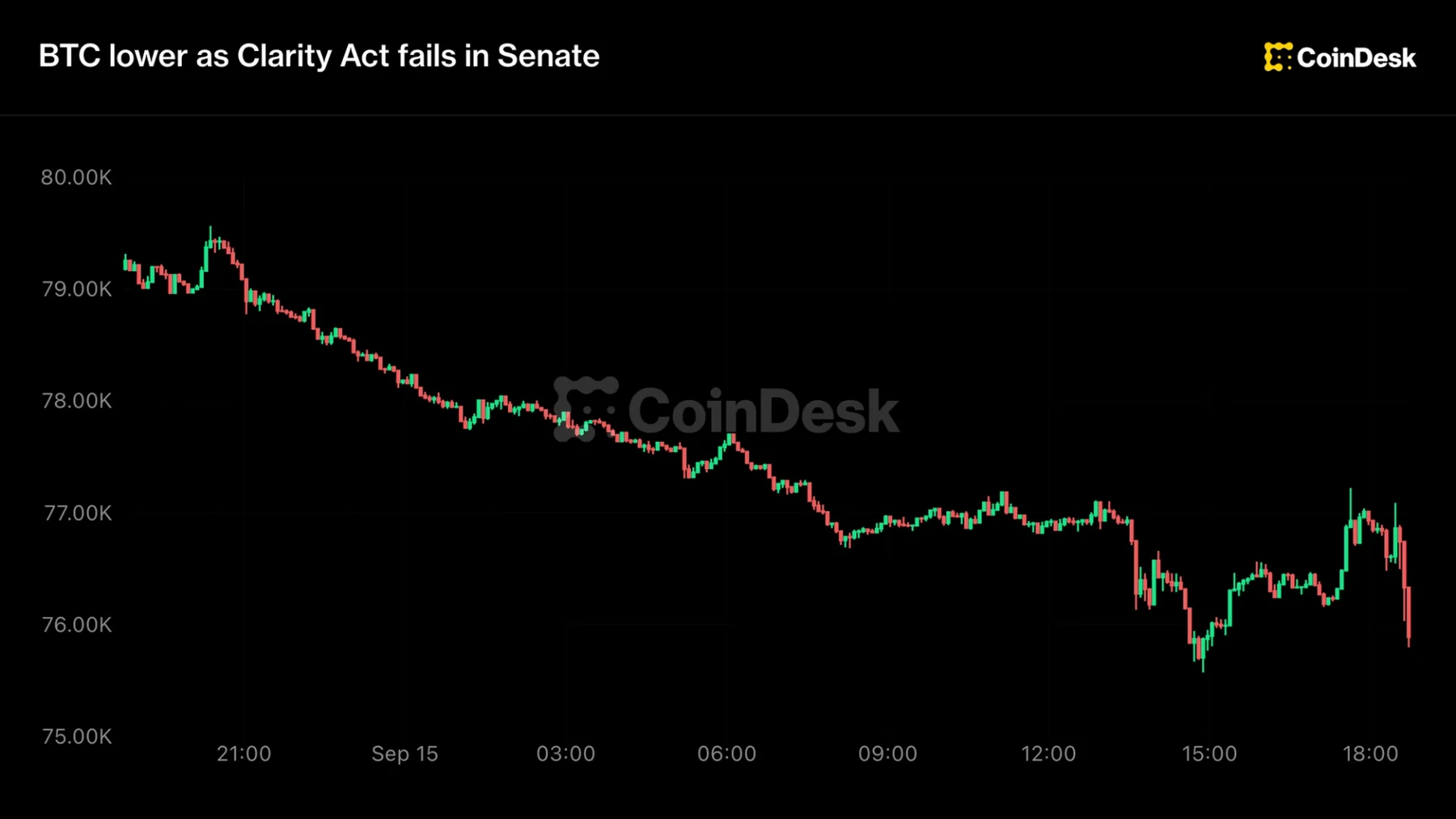
The reported legislative setback coincided with an immediate downward adjustment in cryptocurrency valuations and related equity names across major trading venues. CoinDesk reported that flagship assets such as bitcoin, ether, and solana registered measurable percentage losses over a twenty-four-hour window as market participants digested the failure of the cloture vote. Exchange operators, treasury companies, and publicly traded crypto-related corporations experienced notable equity sell-offs, reflecting investor anxiety over the prolonged absence of federal statutory protection and clear operational guidelines for digital asset businesses.
Market observers highlighted that derivative metrics, including funding rates and open interest, had already signaled a cautious stance among traders ahead of the anticipated vote. Trading desks noted that spot demand cooled significantly, with exchange-traded products experiencing mixed flows as U.S. investors stepped back to the sidelines. While some commentators argued that the downside was partially priced in by derivatives markets due to declining prediction market odds, the realization of the legislative failure nevertheless removed a primary bullish catalyst that market participants had anticipated for much of the preceding months.
Macroeconomic Pressures and Central Banks
In addition to the domestic legislative developments, cryptocurrency markets faced intense pressure from overlapping macroeconomic conditions, notably shifting monetary policy expectations. Reporting from CoinDesk detailed that global bond yields climbed significantly, with the United States benchmark ten-year Treasury yield reaching multi-year highs amidst fiscal sustainability concerns. Investors braced themselves for an aggressive series of central bank decisions, including anticipated interest rate hikes by the Federal Reserve, the Bank of England, and the Bank of Japan, creating a challenging liquidity environment for risk-on assets.
Furthermore, commodity shocks, such as spikes in crude oil prices driven by international supply disruptions, added to inflationary pressures and complicated the macroeconomic outlook. Market analysts noted that the combination of tighter monetary policy and stalled regulatory progress created a formidable headwinds combination for digital currencies. As borrowing costs rose globally and alternative yield-bearing instruments became more attractive, non-yielding assets like bitcoin experienced heightened correlation with broader risk-off sentiment across traditional equity exchanges.
Industry Perspectives and Jurisdictional Shifts
Industry executives and enterprise leaders offered varied assessments regarding the long-term implications of the Senate vote for the United States crypto ecosystem. Representatives from prominent digital asset organizations pointed out that while domestic legislative clarity remains elusive, international jurisdictions continue to establish comprehensive frameworks that attract builders and developers. Prominent voices within the sector warned that protracted regulatory uncertainty in the United States could encourage talent and capital migration toward clearer foreign markets, particularly within European and Asian regulatory zones.
Conversely, some market analysts suggested that the failure of the Clarity Act might not entirely derail industry growth, noting that firms are accustomed to operating under existing legal doctrines. Legal and research commentators observed that without new federal legislation, companies will continue to rely on judicial precedents and administrative guidance from current regulatory bodies. However, corporate compliance departments and institutional investors must now adjust their internal planning to account for continued regulatory fragmentation throughout the remainder of 2026 and into subsequent operational cycles.
Conclusion and Strategic Outlook
In conclusion, the reported failure of the Digital Asset Market Clarity Act in the United States Senate has resulted in an immediate contraction across digital asset valuations and related equities, an outcome not officially confirmed by parliamentary authorities or regulatory bodies. This legislative setback affects cryptocurrency exchanges, institutional investors, and retail market participants by perpetuating regulatory ambiguity under the existing SEC and CFTC oversight framework throughout 2026. What changes now is that market stakeholders must abandon near-term expectations of a unified federal statutory structure and reorient their compliance and strategic deployment plans toward continued multi-agency oversight.
For the next action, affected entities and user groups are strongly advised to consult compliance counsel, monitor ongoing administrative guidelines from federal regulators, and implement rigorous risk management frameworks to navigate heightened volatility. It must be emphasized that the legislative outcome and market declines are based on media reporting and unofficial tallies, and have not been confirmed by an official or first-party source.
Cexvia conclusion
Conclusion and Outlook
The reported failure of the legislative measure has triggered a downward movement in major digital assets and crypto equities, not officially confirmed by the issuers or regulatory agencies themselves. Market participants observed significant pullbacks across spot tokens and derivatives as prediction markets and traders reacted to the collapsed bipartisan negotiations.
- Risk meaning
- The absence of federal market structure legislation leaves digital asset enterprises operating under existing, fragmented regulatory oversight by the SEC and CFTC. Exchanges and institutional investors face prolonged legal ambiguity, which can impact product rollout timelines and compliance operational costs across the sector.
- User action
- Traders and market participants are advised to monitor macroeconomic indicators, central bank decisions, and exchange liquidity metrics closely while managing leveraged positions carefully. Exchange users should verify margin requirements and maintain robust risk management protocols amid heightened market volatility.
Continue reading