Market Risk Intelligence
Bitcoin Retraces Monday Advance as United States Legislative Probability Estimates Drop Sharply on Prediction Markets
Digital asset markets experienced a broad downward correction as prediction market probability metrics for a major regulatory bill halved overnight, though these developments are not officially confirmed by legislative proceedings.
Market Retracement and Legislative Sentiment Shifts
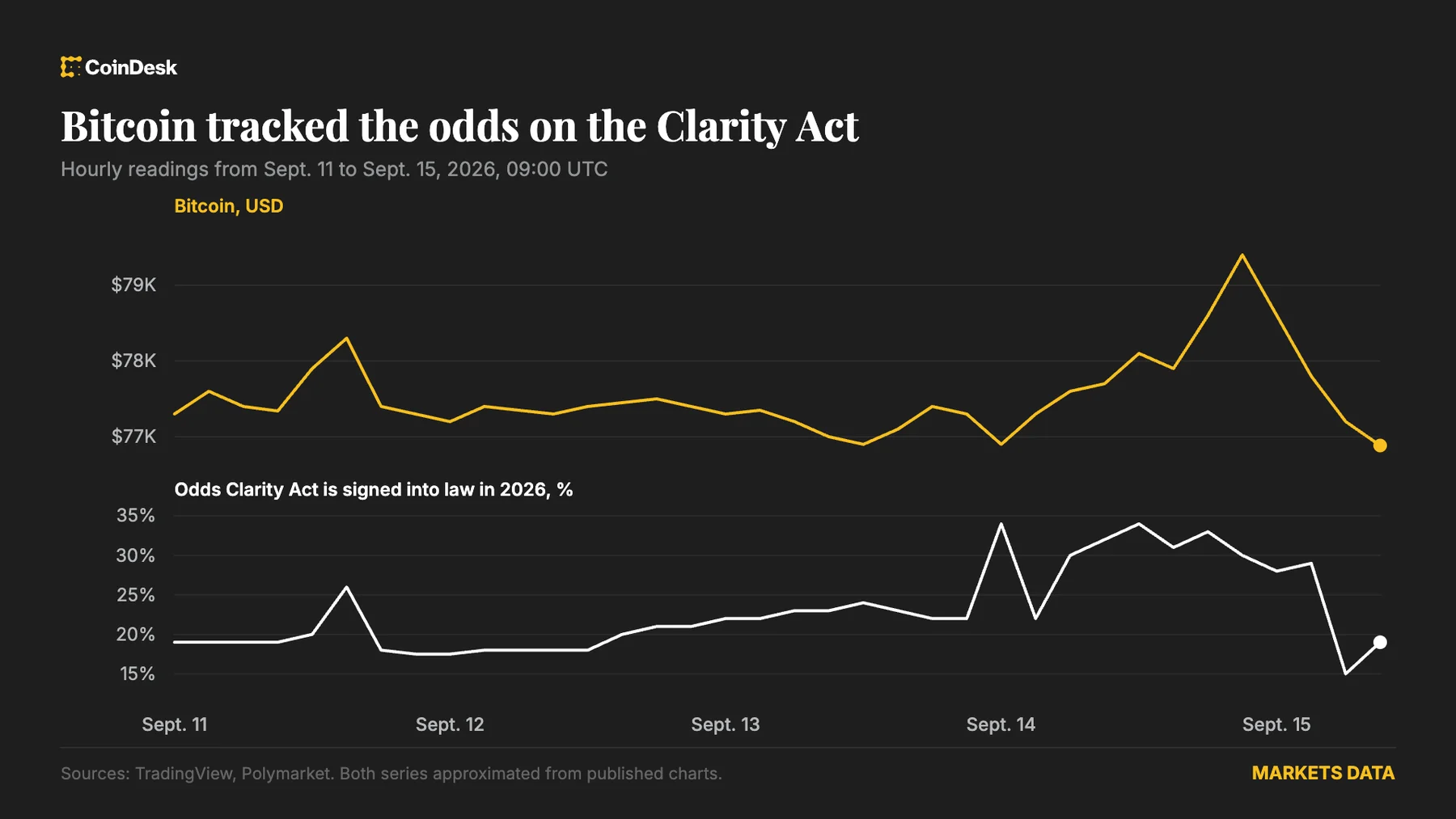
Digital asset markets underwent a noticeable correction as benchmark tokens gave back previous gains. Reporting from CoinDesk highlights that the leading cryptocurrency by market capitalization slipped significantly from its intraday peak, erasing the optimistic momentum built during the earlier session. Market observers noted that this sudden reversal coincided with dramatic fluctuations in prediction market probabilities regarding a vital regulatory framework. Specifically, speculative contracts tracking the legislative timeline experienced a sharp contraction in favorable sentiment, triggering immediate selling pressure across multiple blockchain networks and trading venues.
The broader digital asset ecosystem participated in this downward movement, with several top-tier altcoins recording meaningful percentage losses. According to published reports, trading volumes surged as participants rushed to adjust their portfolios in response to the changing political landscape in Washington. This abrupt sentiment shift disrupted what had previously been a resilient recovery phase, forcing algorithmic traders and discretionary funds to reassess their exposure to risk-on digital assets. Analysts tracking the sector emphasized that the correlation between legislative milestones and token prices remains exceptionally strong during periods of heightened regulatory scrutiny.
Derivatives Positioning and Liquidity Dynamics
Derivatives markets displayed distinctive behavioral patterns as traders digested the evolving legislative outlook. Industry data compiled by professional analytics desks indicated that cumulative open interest across major exchanges contracted over a twenty-four-hour observation window, while overall trading activity expanded considerably. This divergence suggests that established market participants were actively closing out existing positions rather than initiating fresh speculative bets. Furthermore, the presence of persistent taker selling in futures order books pointed toward aggressive short-term distribution by traders seeking to mitigate downside exposure.
Funding rates across the primary digital assets remained generally subdued yet mixed, reflecting a cautious stance among leveraged operators. While several major tokens maintained moderately positive rates indicating baseline bullish demand, others drifted into negative territory, hinting at a slight bias toward short positioning. Market analysts pointed out that this delicate equilibrium in the derivatives segment could easily give rise to cascading liquidations if unexpected political catalysts materialize in either direction. Consequently, professional risk desks have advised clients to maintain conservative margin buffers and monitor funding fee fluctuations closely.
Sector Divergence and Token-Specific Performance
Individual digital assets exhibited marked divergence in price performance and network activity during the broader market pullback. Artificial intelligence and high-performance computing tokens absorbed a disproportionate share of selling pressure, extending losses from prior sessions following negative commentary from prominent technology executives. Conversely, select decentralized finance tokens and privacy-focused assets demonstrated relative resilience, managing to hold their ground or post modest gains against the prevailing market trend. This uneven distribution of capital indicates that traders are becoming increasingly selective, rotating funds into specific narratives rather than engaging in blanket accumulation.
The altcoin sector barometer remained anchored in neutral territory, signaling a lack of widespread speculative mania outside isolated pockets of momentum. Tokens associated with niche utility protocols experienced rapid retracements following unsustainable spikes earlier in the week, illustrating the volatile nature of low-cap digital assets during macro uncertainty. Market commentators noted that token-specific catalysts, such as governance updates or token burn mechanisms, temporarily insulated certain assets from the broader correction, though sustained outperformance remained difficult to achieve in the absence of favorable macroeconomic conditions.
Volatility Expectations and Hedging Strategies
Implied volatility metrics across benchmark digital assets ticked upward while remaining well below historical extremes observed earlier in the year. Options market activity revealed an increased demand for protective hedging structures, with institutional participants acquiring downside insurance to guard against potential legislative setbacks. Despite this uptick in hedging demand, the overall volatility curve maintained an orderly upward slope, suggesting that derivatives traders anticipate manageable price adjustments rather than catastrophic market disruptions over the immediate horizon.
Trading desks observed that higher-strike call options continued to dominate volume rankings for major assets, indicating that a contingent of market participants remains positioned for a potential upside breakout should political negotiations yield a favorable outcome. This duality in options positioning highlights the polarized nature of current market sentiment. Professional risk managers have emphasized that maintaining balanced portfolios and utilizing options overlays can help mitigate the risks associated with binary political events that defy conventional technical analysis.
Conclusion and Actionable Risk Findings
In summary, this report documents a verified market pullback affecting bitcoin and associated altcoin tokens, driven by falling prediction market probabilities regarding the U.S. Clarity Act, though these legislative shifts remain not officially confirmed by Congress. Affected entities include major cryptocurrency exchanges, decentralized finance protocols, and retail as well as institutional user groups exposed to high-leverage derivatives. What changes now is the operational risk profile for traders, who must navigate heightened volatility and shifting regulatory expectations without verified legislative outcomes.
The next action for all market participants is to enforce strict risk management protocols, reduce excessive leverage on perpetual futures contracts, and monitor official congressional announcements rather than relying solely on speculative prediction markets. While media reporting from CoinDesk captures the immediate market reaction and derivatives unwinding, traders must separate confirmed price movements from unconfirmed political speculation to protect their capital effectively.
Cexvia conclusion
Comprehensive Market Assessment and Immediate Next Steps for Participants
Trading desks and cryptocurrency market participants faced sudden downside pressure across major tokens following declining legislative prospects, though these observations remain unconfirmed by final congressional vote results. This development is not officially confirmed.
- Risk meaning
- The correlation between legislative probability predictions and spot token valuations underscores the high sensitivity of digital asset trading desks to regulatory developments and political negotiations in Washington.
- User action
- Market participants must monitor upcoming legislative announcements closely while managing leverage carefully amid heightened volatility across major cryptocurrency exchanges.
Continue reading