Security Risk Intelligence
Whitehats move 52 bitcoin from the Coldcard hack to a recovery trust
According to reporting by CoinDesk citing Galaxy Digital, ethical hackers have transferred approximately 52 bitcoin linked to a prior hardware wallet exploit into a newly established recovery trust. This development, which remains not officially confirmed by independent direct parties, involves funds secured during subsequent waves of the security breach.
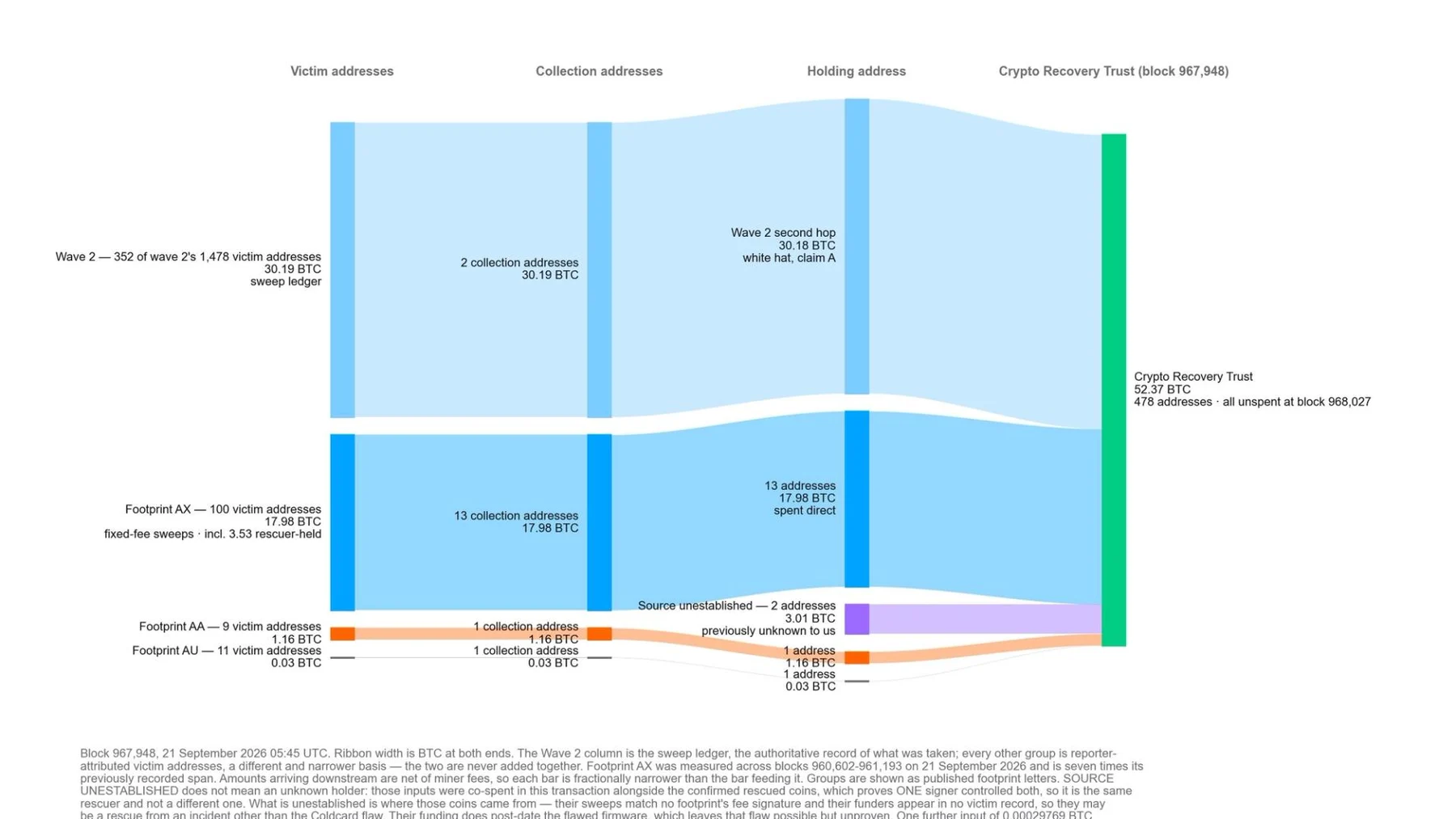
Overview of the Hardware Wallet Vulnerability and Subsequent Fund Movements
Recent market coverage by CoinDesk detailed an ongoing series of security events originating from a hardware wallet exploitation campaign that began on July 30. According to research findings published by Galaxy Digital, malicious actors previously leveraged weak software-based randomness sources to reconstruct wallet seeds, bypassing dedicated hardware random number generators. This architectural flaw enabled unauthorized access across multiple waves of attacks, accumulating estimated losses exceeding one hundred million dollars in digital assets. Coinkite, the manufacturing entity behind the affected hardware devices, subsequently released firmware patches to address the underlying vulnerability. Nevertheless, digital assets already exposed under previously generated seeds remained entirely vulnerable regardless of subsequent firmware updates applied by device owners.
Within this challenging operational context, digital asset researchers have tracked secondary movements involving both malicious entities and ethical operators seeking to safeguard vulnerable balances. Galaxy Digital's research team highlighted that a portion of the compromised funds was redirected away from attacker control by independent cybersecurity professionals attempting to preserve user assets. These proactive interventions formed part of a broader mitigation effort across multiple attack waves, attempting to secure exposed capitals before malicious actors could successfully liquidate them across decentralized or centralized trading venues. The complexity of these recovery operations underscores the persistent difficulties inherent in managing large-scale cryptographic security breaches within decentralized financial ecosystems.
Analysis of White-Hat Interventions and Recovery Trust Establishment
According to published statements by Galaxy Digital Head of Research Alex Thorn, white-hat operators successfully transferred 52.37 bitcoin into a designated recovery trust address. This specific transaction, which was officially recorded on-chain within block nine hundred sixty-seven thousand nine hundred forty-eight, represents approximately 2.8 percent of the total tracked exploit funds. The consolidated assets originated primarily from the second wave of the tracked exploit alongside specific blockchain footprints labeled as AA, AU, and AX. Furthermore, the receiving destination address prominently displayed an embedded OP_RETURN message directing interested parties toward an external domain designated for restitution claims. Industry observers noted that roughly 40 percent of the second attack wave has now been successfully identified as originating from white-hat defensive sweeping activities.
In addition to the primary consolidation of swept assets, researchers identified an additional volume of approximately three bitcoin entering the same recovery trust address without any prior tracking history. While analysts presume these supplementary funds represent further recovery actions conducted by ethical cybersecurity defenders, researchers explicitly emphasized that this specific assertion remains unconfirmed by direct first-party entities. The reliance on on-chain data analysis to classify defensive actions highlights the opacity often accompanying decentralized security incidents, where formal confirmations from legal administrators or institutional trustees are frequently delayed. Market participants must carefully evaluate these structural limitations when attempting to interpret the ultimate destination of recovered cryptographic holdings.
Verification Procedures and Challenges for Impacted Wallet Holders
Individuals who suffered financial losses stemming from the compromise of vulnerable Coldcard hardware configurations are currently navigating a complex verification landscape. Published reports indicate that affected users can visit a dedicated web portal to search their specific wallet addresses and determine whether their funds were successfully recovered by ethical operators. However, navigating such recovery portals introduces substantial security hazards, as malicious actors frequently deploy fraudulent phishing websites mimicking legitimate trust mechanisms to steal credentials. Users are strongly advised to verify domain names meticulously and refrain from inputting sensitive private keys or seed phrases into unverified web applications under any circumstances.
The absence of centralized regulatory oversight governing these informal white-hat trusts complicates the restitution process for average retail participants. Without official cryptographic verification or legal binding agreements endorsed by recognized authorities, holders face significant uncertainty regarding the eventual return of their assets. Furthermore, the fragmented nature of blockchain investigations means that multiple competing recovery initiatives could emerge simultaneously, increasing the potential for user confusion and targeted scams. Comprehensive risk management requires affected participants to rely strictly on verified communication channels provided by established security researchers rather than speculative social media announcements.
Industry Implications and Technological Lessons from the Security Breach
The Coldcard exploitation campaign serves as a critical watershed moment for hardware wallet manufacturers and the broader cryptographic storage industry regarding entropy generation security. The reliance on software-based randomness sources rather than robust, auditable hardware random number generators exposed systemic architectural vulnerabilities that compromise foundational trust models. Hardware wallet providers must fundamentally reevaluate their firmware auditing practices, supply chain verifications, and cryptographic initialization procedures to prevent similar catastrophic failures. Peer-reviewed security assessments and transparent open-source codebases are increasingly recognized as essential prerequisites for maintaining institutional and retail confidence in secure storage devices.
Moreover, the emergence of white-hat recovery operations as a semi-formal mechanism for mitigating exploit losses highlights the evolving dynamics of incident response within cryptocurrency markets. While ethical hacking interventions successfully rescued millions of dollars in digital assets during this specific incident, relying on vigilante remediation remains an imperfect substitute for robust security engineering. The broader ecosystem must develop standardized, legally sound frameworks for white-hat cooperation and asset recovery to protect users without inadvertently exposing them to new vectors of fraud or legal liability.
Conclusion, Verification Status, and Actionable Steps for Affected Users
In conclusion, independent reporting by CoinDesk citing Galaxy Digital indicates that white-hat operators have moved 52.37 bitcoin associated with the July Coldcard exploit into a newly formed recovery trust address. However, this development remains not officially confirmed by the affected hardware manufacturer, legal authorities, or direct trustees, highlighting the preliminary nature of these on-chain findings. The affected entity is identified as Coinkite, and the primary user group comprises owners of hardware wallets manufactured during the vulnerable production window who suffered seed generation compromises. The immediate change involves the establishment of on-chain recovery addresses and search portals designed to facilitate asset identification, though the final legal and operational framework for asset distribution remains entirely unverified.
As the next mandatory action, affected individuals must exercise extreme vigilance, avoid interacting with unverified third-party recovery websites, and monitor official communications from reputable security researchers. Users must separate confirmed on-chain data from unverified claims regarding additional fund movements and refrain from sharing sensitive private credentials under any circumstances. Monitoring official security advisories will remain critical as further details regarding the recovery trust operations emerge across the digital asset ecosystem.
Cexvia conclusion
Conclusion and Verification Status
CoinDesk reported that white-hat operators moved 52.37 bitcoin connected to the July Coldcard vulnerability into an address associated with a recovery trust. This finding remains not officially confirmed by the wallet manufacturer or legal administrators.
- Risk meaning
- The involvement of ethical hackers in sweeping vulnerable cryptocurrency holdings highlights ongoing efforts to mitigate massive losses from hardware seed vulnerabilities. However, the reliance on unverified recovery trusts introduces complex operational risks for affected users seeking asset restitution.
- User action
- Affected individuals who utilized vulnerable hardware configurations must exercise extreme caution, verify official communications carefully, and avoid interacting with unverified web portals claiming to facilitate asset returns without cryptographic proof.
Continue reading